
Quantum untuk Rakyat
What exactly is quantum computing?
Welcome to Quantum Computing: Understanding the Technology and its Implications. Quantum computers are not simply more powerful laptops. Classical computers process bits; quantum computers use qubits, which exploit quantum properties including superposition, entanglement and interference. Quantum devices can be particularly powerful for some complex problems, rather than everyday office tasks.
Classical vs Quantum
Uses bits to represent information.
Uses qubits, which can exhibit superposition and entanglement.
Three key principles
Quantum states can be combinations of 0 and 1.
Qubits can exhibit correlated quantum states.
Quantum amplitudes can reinforce or cancel outcomes.
What does it mean when a qubit is in a state of superposition?
Why is interference important in quantum computing?
What makes entanglement powerful for computing?
What problems could quantum computing solve?
Quantum computing is an emerging field. Its potential applications range from healthcare and molecular simulation to cryptography, scientific modelling and certain forms of machine learning. These possibilities remain research directions, not universal or guaranteed speedups.
Five potential problem areas
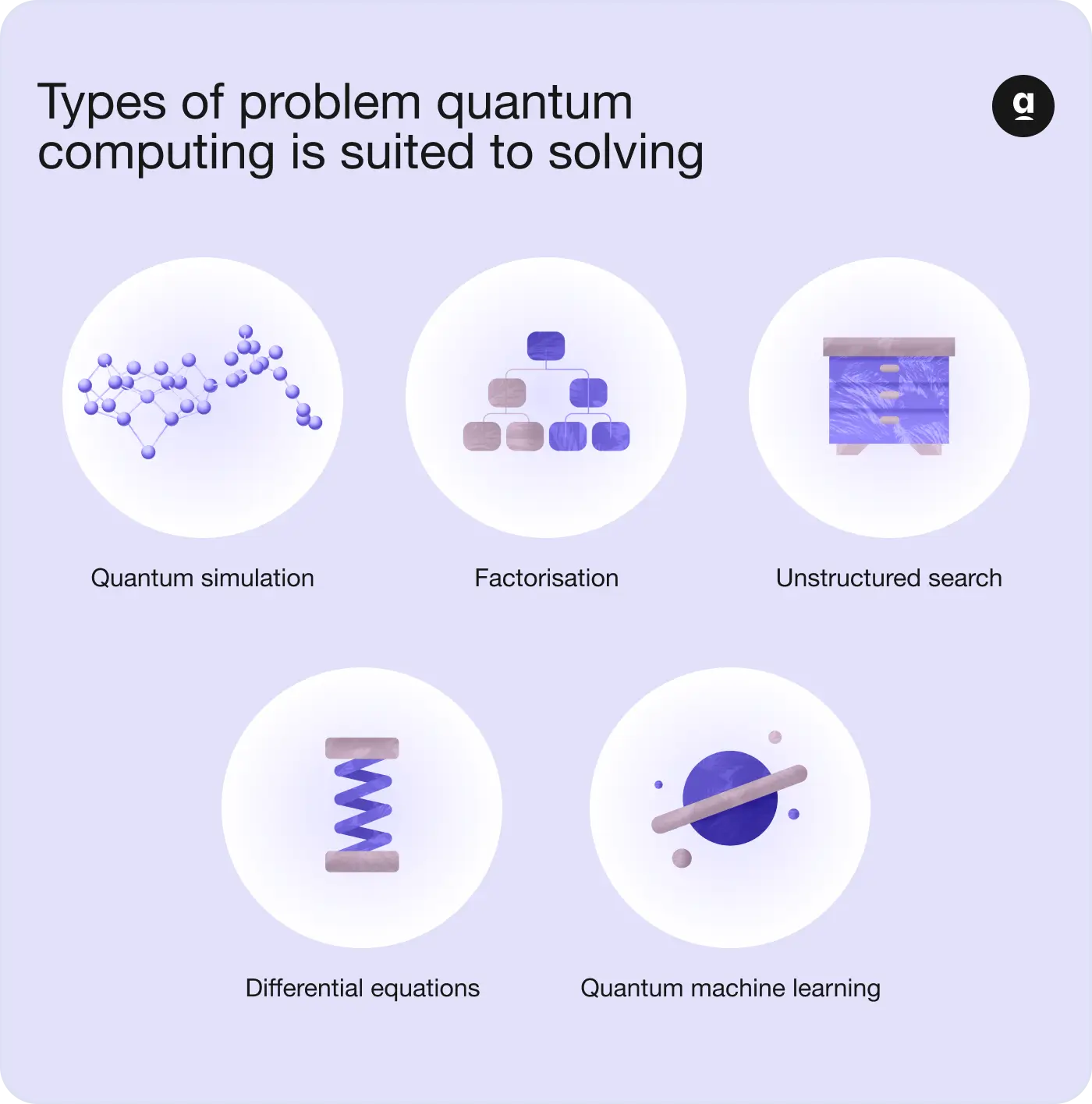
Quantum simulation — replicating nature
Quantum computers may help model molecules and proteins, enabling discoveries in materials and medicine.
Factorisation — breaking encryption
Large-scale fault-tolerant quantum computers could threaten some present-day public-key cryptography. Post-quantum cryptography is being developed in response.
Unstructured search — smarter data searching
Some search and optimisation tasks may benefit, but moving large datasets into quantum systems can create bottlenecks.
Differential equations — designing resilient systems
Researchers are exploring quantum approaches to complex mathematical models in engineering, climate science and economics.
Quantum machine learning
Specialised quantum algorithms might support certain machine-learning tasks, particularly those involving quantum data.
Case study: Fertiliser production
The Haber–Bosch process is energy-intensive. Future quantum simulation might help scientists model its chemistry and investigate more efficient production methods.
Further reading: Quantum computing for smart agriculture ↗
Which of these are potential future use cases of quantum computing? Choose two.
Quantum computers are expected to crack modern encryption methods in the next two years.
Why might quantum computers not speed up all optimisation tasks?
Current modalities and limitations
There are five leading modalities being explored: superconducting circuits, trapped ions, photonic systems, neutral atoms, and silicon-based quantum dots. Today’s machines are often described as NISQ (Noisy Intermediate-Scale Quantum): small and error-prone. Researchers are working on qubit quantity, coherence, gate speed, gate fidelity, error correction and scalability.
Five quantum computing modalities
Superconducting
Artificial-atom qubits fabricated on chips and controlled by microwave pulses, operating at very low temperatures.
Trapped ions
Charged atoms held using electromagnetic fields and controlled with lasers.
Photonic
Uses particles of light and optical components to manipulate and measure quantum states.
Neutral atoms
Atoms held in a vacuum and arranged and controlled using lasers.
Silicon-based quantum dots
Uses quantum states in tiny semiconductor structures.
Current limitations
Qubit quantity
Current systems do not have enough high-quality qubits for many ambitious applications.
Qubit quality and coherence
Environmental noise can disturb fragile quantum states.
Gate time and fidelity
Operations must be fast and accurate enough to perform calculations before errors accumulate.
Error correction
Multiple physical qubits can be combined to protect a logical qubit, but this needs considerable hardware overhead.
Scalability
Increasing qubit counts also creates challenges in wiring, cooling, control and cost.
Further reading: Neutral-atom platform ↗
What does the term NISQ stand for in quantum computing?
Adding more qubits to a quantum computer always increases its computational power.
Which is the correct definition of qubit coherence?
What applications are researchers looking for?
The challenge is not just making quantum computers work, but identifying valuable applications. Quantum advantage depends on solving problems that are difficult for classical computers and useful in practice. Hybrid systems combine classical computing with quantum processors to experiment with near-term use cases.
What about hybrid quantum computers?
Hybrid systems perform much of the computation on classical hardware while using quantum resources for selected parts of a problem. Cloud-accessible quantum platforms can help researchers test algorithms without owning quantum hardware.
Scott Aaronson — Scientific exploration
Quantum computing could offer new ways to explore chemical reactions, materials and fundamental physics.
Freeke Heijman — Climate solutions
Future applications could support cleaner materials, air and nutrition.
Edward Parker — Scientific discovery
Potential benefits include advances in batteries, energy technologies and drug discovery.
Further reading: Hybrid quantum computing ↗
Which two criteria must quantum computers meet to achieve quantum advantage?
Only a small number of applications have been proven to show quantum advantage so far.
Which best describes hybrid quantum computers?
What are your key takeaways?
Review the fundamentals: qubits and quantum mechanics; five potential application areas; five hardware modalities and NISQ limitations; and the importance of finding useful problems and exploring hybrid quantum systems.
Review each module
Module 1 — Fundamentals
Classical bits versus qubits; superposition, entanglement and interference.
Module 2 — Potential applications
Simulation, factorisation, search, differential equations and quantum machine learning. Quantum is not a universal replacement for classical computing.
Module 3 — Hardware and limitations
Five modalities; the NISQ era; qubit quantity and quality, noise, gate fidelity, error correction and scalability.
Module 4 — Finding useful applications
Quantum advantage and hybrid quantum computing.