
AI Fluency
5 modules · AI basics, generative AI, internet search, responsible AI and accessibility
Explore AI basics
Introduction
Imagine you're at home, enjoying a relaxing evening. Your robot vacuum cleaner starts its cleaning routine just as you turn on your smart TV, which immediately suggests new shows for you to watch. Curious about one of the shows, you ask your smartphone for its current ratings. Then, with a simple voice command, you use your cell phone to turn on the living room lights. Intrigued by how seamlessly these devices work together, you search for how each functions and discover that they all use AI.
AI is all around us and has been evolving for decades. This module guides you through the basics of AI, starting with its rich history. You'll explore what AI is, how it differs from human intelligence, and how data is the key that unlocks AI's potential. By the end of this module, you'll understand the fundamentals of AI, the different types of AI, and how it interacts with human language. Finally, you'll see AI in action through various algorithms and real-world applications in items.
AI history
To appreciate advancements like smart home devices, it's helpful to be aware of the history of AI. From its beginnings with the simple rule-based systems of the 1950s, to the advanced algorithms of today, AI evolved continuously and significantly.
This video reveals how AI concepts and breakthroughs paved the way for the intelligent devices and applications we rely on daily. By exploring AI's past, we gain insight into how it evolved to become an integral part of our modern world, impacting everything from our homes to our workplace.
AI development timeline
The history of AI is rich and spans several decades, with significant milestones that shaped its development. To fully appreciate how we got to AI today, we need to understand the origins of AI.
Early concepts
The idea of using machines to assist with calculations dates back to as early as 380 BCE.
The early years
In 1950, Alan Turing, a pioneer in computing, posed a profound question: "Can machines think?" This question marked the beginning of a new era in technology.
In 1956, computer scientist John McCarthy first coined the term "artificial intelligence" during the Dartmouth Summer Research Project on AI. This event marked the beginning of AI as a field of study.
In 1956, the Logic Theorist, considered the first AI program, was developed.
Early developments
In 1966, Joseph Weizenbaum created ELIZA, the first AI chatbot designed to simulate conversation.
In 1968, Alexey Ivakhnenko introduced the "Group Method of Data Handling," a precursor to modern deep learning.
1990s
2000s
2010s
Today
The 1990s saw significant advancements, including the development of Deep Blue, the first AI system to defeat a reigning world chess champion in 1997. This decade also saw the creation of Kismet, a robot capable of recognizing human emotions through facial expressions.
What is artificial intelligence?
Smart home devices, combined with the rise of useful generative AI services like Microsoft Copilot turned AI into a popular conversation topic. You now see AI isn't new; it's been part of our lives for years. At times, AI might seem like a new transformative force, but the evolution of AI spans decades. Along the way, it became more intertwined in our everyday lives. At its core, AI is the capability of a computer system to mimic human cognitive functions such as learning and problem solving. By using math and logic, AI systems can simulate human reasoning, make predictions, and take actions based on patterns in existing data.
In the first video, you'll discover what AI is and how it was first explored back in the 1950s.
Now that you know what AI is, another compelling topic is the distinction between knowledge and intelligence. While often used interchangeably, they're different concepts. In the next video, you'll learn about the distinct differences between both.
Knowledge refers to the accumulation of facts, information, and skills gained through education or experience. Intelligence is the ability to apply knowledge to think abstractly, as measured by objective criteria such as problem-solving.
AI isn't knowledgeable in the way humans are. AI systems can process, analyze, and make predictions based on the data they receive. This ability might give the impression that AI is knowledgeable, but it's different from human intelligence. AI can only simulate knowledge based on the parameters set by its programming and the data it was trained on. AI doesn't work without data; it forms the foundation of AI's abilities and determines how well it can simulate knowledge.
Data everywhere
Thinking back to household smart devices, you might wonder: How does a streaming app know what to recommend to you? How does my robot cleaner know where to clean? Well, data plays a crucial role. These devices rely on data to operate efficiently. Data is collected to make your experience more personalized and automated.
Data is information that is collected, stored, and used for various purposes. It can come in many forms, such as text, images, and numbers. AI utilizes data for learning and reasoning. For example, when you consistently watch shows of the same genre on a streaming app, this data helps the AI model determine what to recommend to you next.
In the first video, you'll gain an understanding of what data is and why it's essential for advancing AI.
Data allows AI to learn, adapt, and make informed decisions. However, it isn't just about the quantity of data available but also the quality. The effectiveness of AI models is directly tied to the quality of the training data.
In the next video, you'll discover why finding patterns in data is important and how it can enhance user experience.
AI models use data to identify patterns. At the core of this process are algorithms that analyze data fields, learning from the patterns within the data to generate models. These models are then used to make predictions or decisions about new data. This process is called machine learning.
The quality and quantity of the data are crucial. High-quality data ensures that the AI model can learn accurately and make reliable predictions. Poor-quality data can lead to incorrect outcomes. Therefore, data preprocessing, which includes cleaning and organizing data, is an essential step in the machine learning process.
Understand machine learning
Machine learning involves feeding large amounts of data into an algorithm, which then processes this data to find patterns and relationships.
For example, if you provide an AI model with data about your past vacuuming habits and the layout of your home, the model that results could be used to program a robot vacuum to sweep your carpet in a similar pattern to you. Now imagine many of these robots were sold, transmitting all their vacuuming data back to the developer. Using machine learning to detect patterns could discover even more efficient movement patterns and optimize paths for all robot vacuums with the same design.
In the first video, you'll gain a better understanding of what machine learning is.
Machine learning is an AI technique that uses algorithms to create predictive models. These models are validated against known data, measured by specific metrics, and adjusted as needed. This process of learning and validation is called training. Through retraining, machine learning models improve overtime. There are also key methodologies on how to train models, for example, supervised learning, unsupervised learning, and reinforcement learning.
In the next video, you'll learn the difference between these methodologies, and be introduced to their combination in layers, called deep learning.
Deep learning
Deep learning is a subset of machine learning that utilizes artificial neural networks to excel at identifying patterns. Deep learning uses large datasets and complex algorithms to achieve higher levels of accuracy and performance.
In the video, you'll learn how deep learning expands what AI is capable of and how it's changing technology today.
Natural Language Processing (NLP)
Natural Language Processing, or NLP, is a branch of AI that focuses on the interaction between computers and humans through natural language. NLP uses machine learning to understand, interpret, and generate human language.
NLP enables applications that include text analysis, question answering, conversational language, speech recognition, and speech synthesis.
In the video, you'll be introduced to NLP and how it's transforming the way we interact with technology.
Natural Language Processing, or NLP, is a branch of AI that enables computers to understand, interpret, and generate human language. NLP enables techniques for sentiment analysis, key phrase extraction, language detection, named entity recognition, text summarization, and real-time translation. These capabilities are features in applications spanning customer service, healthcare, business intelligence, and content management.
AI algorithms
Your understanding of the devices and systems around you just got complex, fast. All of the methodologies are made of the same algorithmic building blocks, combined in different ways depending on the data and the larger function they perform together. The different types of these AI algorithms, are classification, optimization, regression, and clustering.
In the video, you'll learn about different types of AI algorithms and how they're being used today.
AI algorithms are the backbone of many technologies we use today, powering household items like smart watches and smart thermostats. These algorithms enable machines to perform tasks that typically require human intelligence by analyzing data and learning from patterns. AI algorithms are crucial for the functioning and advancement of machine learning, deep learning, and NLP technologies.
AI in action
Now that you have a solid understanding of what AI is, the importance of data, machine learning, deep learning, and natural language processing, and how algorithms form the backbone of AI, it's time to see this technology in action.
In this video, you'll witness how AI is integrated into everyday items and services. You'll be introduced to practical applications of AI and understand how it seamlessly operates in the background to enhance your daily life. From smart home devices that learn your preferences to AI-powered services that make your interactions more efficient, this video showcases the impact of AI on our daily routines.
AI is all around us. From our homes to our workplaces, and even during our commutes, AI keeps us connected and enhances our experiences. As AI continues to advance, we're witnessing the emergence of new models and technologies, such as Generative Pretrained Transformers, or GPTs and Large Language Models known as LLMs. In the next module, you'll be introduced to these technologies and the new concepts that are shaping our world today.
Module assessment
1. Which of the following statements best describes the relationship between AI, machine learning, and deep learning?
2. Which algorithm would be the most appropriate for predicting house prices and why?
3. Which milestone most significantly contributed to the practical applications of AI in every day life and why?
Explore Generative AI
Introduction
Sometimes getting started on a project is hard, especially when you have a great idea, but find yourself facing writer's block. This is where generative AI services, like Microsoft Copilot, can offer valuable support. Generative AI is a newer technology that can assist in unique and innovative ways. For example, Microsoft Copilot can help you craft an opening line to hook your readers or organize your thoughts into coherent chunks. If you need inspiration for illustrations, generative AI can help with that too.
In this module, you'll explore the concepts of generative AI, discover how it differs from traditional AI, and understand the crucial role of data in unlocking its full potential. By the end, you'll have a solid understanding of generative AI and how it can transform your creative process and other aspects of your life.
What is generative AI?
Generative AI is transforming the approach to productivity. Recent advancements in AI greatly improved natural language processing and generation. These technologies now enable the creation of images, videos, texts, and audio from simple descriptions, transforming how you interact with technology.
This video reveals how generative AI can provide support in the creative process and enhance productivity, highlighting its potential to reshape various industries by empowering people to achieve more with less. By automating repetitive tasks and providing creative suggestions, generative AI allows you to focus on what truly matters: envisioning innovative ideas, setting ambitious goals, and pursuing your dreams.
Now that you have the foundations down, you might be curious about how it works. Generative AI functions through AI models, which are mathematical structures that learn from patterns in data using algorithms. There are several types of AI models with varying capabilities. Some AI models are designed to identify and classify information, while others, like generative AI models, excel in creating content.
This video shows how the use of generative AI models varies based on one's technical ability. For example, experts can customize these models for complex tasks, while beginners can use preexisting models or tools with minimal technical knowledge.
Generative AI is changing the way you interact with technology, from creating content to helping with complex tasks. These advancements enable AI to understand and process human language, fostering a more natural interaction.
AI linguistics
You might come across some interesting AI acronyms such as Large Language Models (LLMs) or Natural Language Generation (NLG). These acronyms are a part of a branch of AI called Natural Language Processing (NLP).
You might come across some interesting AI acronyms such as Large Language Models (LLMs) or Natural Language Generation (NLG). These acronyms are a part of a branch of AI called Natural Language Processing (NLP).
The video explains the meaning behind the acronyms and how this branch of AI is changing how humans interact with AI.
Natural Language Processing (NLP) is a branch of AI that helps computers understand and respond to human language. Recently, Large Language Models (LLMs) improved NLP applications.
LLMs are advanced AI models trained in large amounts of text data. They predict words in sequences, enabling them to perform tasks like text generation, summarization, translation, and classification.
LLMs are a key part of generative AI, which focuses on creating new content. By using LLMs, generative AI can produce human-like text, making it a useful tool in content creation.
Visualize with AI from text to image
With generative AI, visualizing ideas is more accessible than ever. One of the most exciting advancements is its ability to transform text descriptions into images. This technology, known as text-to-image generation, uses AI models to interpret text into visual representations. Imagine you've written a short story and want illustrations to bring it to life. By describing a scene through text, AI can create illustrations that match your description in no time, helping you find inspiration quickly or even critically analyze your story visually to see if you want to make any changes to enhance it further.
This technology isn't limited to authors. Designers, marketers, educators, and anyone with a creative vision can benefit from it. For instance, a teacher could describe a historical event and have AI generate an image to make the lesson more engaging for students. A marketer could visualize a campaign concept before it's executed. The possibilities are endless.
This video will introduce you to text-to-image technology and how you can access it today in Microsoft Copilot. By leveraging tools like DALL·E, integrated into Microsoft Designer, you can turn your textual descriptions into vivid images, bridging the gap between imagination and reality. Whether you're looking to enhance a story, create visuals for a project, or simply explore your creativity, text-to-image AI is a powerful tool at your disposal.
Generative AI is unlocking new possibilities for the creative process. With text-to-image generation, you can bring your ideas to life visually. In the next lesson, you'll learn how AI can further assist you in content creation, making it an invaluable companion in your creative journey.
AI companion in content creation
Generative AI offers various technologies to assist in idea creation. This video will cover a few examples, such as text-based generation, text-to-image generation, audio generation, and video generation. Each technology offers unique ways to bring your ideas to life.
For example, text-based generation can help draft content or brainstorm new concepts. Text-to-image generation can transform your textual descriptions into vivid images. Audio generation can create music or sound effects based on your prompts. Video generation can produce visual content from text, simplifying the creation of engaging videos without requiring extensive editing skills.
The video will show how you can use these technologies today, highlighting their potential to enhance creativity and streamline the idea creation process. Whether you're exploring new ideas or bringing your visions to life, generative AI technology can significantly expand your creative toolkit.
Generative AI technology offers a fresh set of tools for creativity, enabling you to push the limits of your aspirations and goals.
New opportunities with generative AI
Throughout history, technological advancements influenced the way we work. Today, AI is leading a new wave of change by introducing innovative ways to manage workplace tasks and redefining economic opportunities.
The video explores how AI creates these new opportunities, highlighting its potential to enhance your professional goals and everyday tasks. From automating routine tasks to giving personalized career advice, AI is changing the landscape. Whether you're aiming to improve your current role or explore new career directions, AI offers tools and insights to help you navigate these opportunities.
Generative AI isn't just a tool for automation, but a powerful ally in enhancing creativity, problem-solving, and career development.
Exercise: Create with generative AI
Now it's your turn to use generative AI. Choose the scenarios that fits your current need, and leverage generative AI to generate the content you need to make progress.
Scenario 1: Planning a project
Use generative AI to help plan a project you're blocked on, or to provide guidance for your career development based on your goals and current skill levels.
1. Identify a Blocked Project: Choose a project you're currently working on or want to complete, that doesn't have a plan yet, or is blocked in some way.
2. Generate an Outline:
Use a generative AI tool to create an outline for your project.
Include key milestones, tasks, and deadlines.
3. Refine the Outline:
Review the generated outline and make necessary adjustments, by asking the generative AI tool to try again with the specificity you need.
Ensure it aligns with your project goals and constraints.
Scenario 2: Career development guidance
Use generative AI
1. Set Your Goals: Define your short-term and long-term career goals.
2. Assess Your Skills: List your current skills and identify any gaps.
3. Generate a Career Plan:
Use a generative AI tool to create a career development plan.
Include steps to acquire new skills, a progression of potential job roles, and networking opportunities.
4. Review and Adjust:
Evaluate the generated plan and tailor it to your personal preferences and circumstances.
If the plan generated is incomplete, ask the tool to try again, this time with the components or specificity you need.
Scenario 3: Generating images
You might want to add images to visualize your plan from one of the previous scenarios. Maybe you have a business idea that you just need a fast graphic to add to your test website and sign-up form to validate.
1. Plan your images:
Use generative AI to generate prompts that you use to create images that represent key aspects of your project or career plan.
Be very specific with the style, elements, and other features of the image. The more detail you provide the better.
Know when to use design tools. Image generation is advancing quickly, but may not provide the kind of accuracy you need. If you have existing graphics that you need to incorporate into a new image, it might be best to use graphic design tools for the control you need.
2. Incorporate Images:
Integrate these images into your project documentation or career plan presentation.
Use them to enhance understanding and engagement.
Recommendations
Iterate: Continuously refine your plans and images based on feedback and new insights. Ask generative AI for an outline, then to add more specific content for each section or paragraph. If it does not produce what you need, you can ask it to try again.
Collaborate: Share your plans with peers or mentors for more input and support.
Module assessment
1. Which statement best distinguishes between Natural Language Processing (NLP), Natural Language Generation (NLG), and Large Language Models (LLMs)?
2. Which statement best assesses the difference between generative AI and traditional AI models?
3. Evaluate the following statements and decide which one best assesses how generative AI services, like Microsoft Copilot, can enhance creativity.
Explore internet search and beyond
Introduction
Imagine you're on a mission to find the best pizza place in town. You might use a search engine like Bing for this task. But what if there's a service that can not only identify the best pizza place but also explain why it's the best based on your preferences? This distinction highlights the difference between a search engine and a reasoning engine.
In this module, you examine the functionality of both search and reasoning engines. You explore their processes of crawling the web, indexing discovered information, and ranking results to present the most relevant answers. Additionally, you learn how reasoning engines take those processes further by comprehending and reasoning with the acquired information.
You'll also be introduced to the essential tools and techniques for effectively using reasoning engines. Get ready to learn how to create effective prompts, critique established best practices, and understand the important role of critical thinking in maximizing this new technology.
By the end of this course, you'll have a foundational understanding of search engines and reasoning engines and how to use them. Whether you aim to enhance your search capabilities or grasp the future of AI, this course offers valuable insights.
The evolution of search
The way we search for information has evolved over time. Initially, we relied on physical books and libraries to find the information that we needed, guided by the Dewey decimal system. With the creation of the internet, keyword searches became the norm and helped us quickly find relevant information with just a few clicks.
We've now entered the era of AI-driven queries, which have changed the way we access and interact with information. This advanced search technology uses natural language processing and machine learning algorithms to understand the context and intent behind our queries. The goal is to provide more accurate and relevant results. This shift has made searching for information more intuitive and efficient, so we can find what we need faster and with greater precision.
In this video, you explore the evolution of search from the pre-internet era to the present day with advanced search engines like Bing and Microsoft Copilot:
The way we search for information has undergone another transformation. In the past, we relied on text-based searches: typing out a question and searching through results. Today, we can search through text, voice, or even images. This flexibility has made finding information more accessible.
How does a search engine work?
We all use search engines in our daily routines to find information swiftly, whether it's for writing a research paper or locating a restaurant in town. A complex web of technology works behind the scenes to make this ability possible.
In this video, you explore how search engines work by diving into the three fundamental tasks of crawling, indexing, and ranking:
Search engines evolved to help you receive the most accurate and updated information. They begin by crawling and indexing websites. That is, they scan the web and record the content that they discover. They then use this extensive database to rank and fetch the results for your queries.
The algorithms that drive these activities are highly advanced. They're crafted to comprehend the context and purpose behind your searches.
Reasoning engines
With recent advancements in AI, search technology made a leap forward. It evolved into reasoning engines that can understand and process complex queries in a more humanlike manner. Reasoning engines can provide more accurate and contextually relevant answers to make search experiences more intuitive and efficient.
In this video, you explore how these advancements transformed search engines into powerful tools that not only find information but also understand and reason with it:
It's no longer just about finding an answer; it's about creating responses that are informative, relevant, and engaging. Reasoning engines don't just provide answers. They understand the context and nuances of your queries to deliver more personalized responses.
A new way to search: Microsoft Copilot
Microsoft Copilot is changing the way we search for information.
In the following video, you learn how Microsoft Copilot transforms the traditional search experience by combining a large language model with internet knowledge to provide context-aware and tailored results. The video demonstrates various use cases, from planning a trip to generating code, to highlight the ability of Copilot to enhance productivity and creativity.
The Microsoft Copilot interface was recently updated. These video tutorials are still applicable with the new design, although some features might no longer be available.
With Microsoft Copilot, you can achieve more with less effort. Let's review its benefits:
Instead of relying on keywords, it enables natural conversation.
It uses advanced AI to comprehend queries and provide relevant results.
It helps streamline workflows, so you can focus on your strengths.
It offers deep insights and recommendations beyond simple search results.
These advancements make searching more dynamic and efficient. Whether you're looking for the latest research or summarizing a document, Copilot is there to assist. It's not just a search tool but an intelligent assistant that adapts to your needs and enhances your daily tasks.
Effective use of Copilot requires prompt engineering skills and critical thinking, which the next units explore.
Prompt engineering
Prompt engineering is crucial in AI, particularly with advanced language models like GPT-4o in Microsoft Copilot. It entails crafting precise prompts to guide models toward producing the desired results. By refining prompts, you can improve the quality, relevance, and accuracy of AI responses.
In the following video, you explore the concept of prompt engineering. You discover the importance of clear instructions and relevant context to effectively communicate with AI and achieve optimal results.
The following video teaches you how to improve your prompt creation abilities to maximize your effectiveness with Microsoft Copilot. It includes best practices such as being specific, selecting the appropriate style, prioritizing accuracy, and tailoring your experience to make each interaction more productive and enjoyable.
The Microsoft Copilot interface was recently updated. These video tutorials are still applicable with the new design, although some features might no longer be available.
Prompt engineering is essential for working with reasoning engines. Here's how to make your experience more effective:
Be specific: Clearly state your needs.
Use examples: Guide the model by providing examples.
Set the context: Offer enough background and instructions for clarity.
Iterate and refine: Adjust prompts based on responses for improvement.
Limit the scope: Break down tasks to enhance output quality.
Test approaches: Experiment with different phrasings to find what works best.
With these best practices for prompting in your toolkit, the next unit dives into the importance of critical thinking in this process.
Critical thinking
Critical thinking enhances your ability to analyze and evaluate information. These skills are key for making informed decisions, solving problems, and nurturing creativity. When you're using a reasoning engine or generative AI, critical thinking helps assess the engine's output. This assessment helps ensure logical and well-founded conclusions while spotting bias and validating accuracy.
The following video explores the importance of critical thinking when you're engaging with AI. The video provides practical tips on verifying sources, questioning content, and ensuring the ethical use of AI to create accurate and responsible content.
Critical Thinking Skills
1
2
3
4
5
6
Evaluating information
Helps assess the accuracy and relevance of information and identify credible sources.
Developing critical thinking skills improves results from Copilot, aids informed decision-making, promotes constructive engagement, and fosters better personal and professional outcomes. It also contributes to a more united, tolerant, and innovative society.
Critical Thinking Skills
Evaluating information
Assess accuracy, relevance and credible sources.
Making informed decisions
Weigh the pros and cons of Copilot suggestions.
Problem-solving
Understand issues and implement solutions.
Avoiding bias
Recognize and reduce biases in AI outputs.
Enhancing creativity
Challenge assumptions and explore new perspectives.
Communicating effectively
Ensure clear communication with Copilot.
Module assessment
1. Which of the following answers best describes the importance of prompt engineering in AI development?
2. Which of the following answer best assesses the effectiveness of crawling, indexing, and ranking in search engines?
3. Which of these statements best captures the differences between a search engine and a reasoning engine?
Explore responsible AI
Introduction
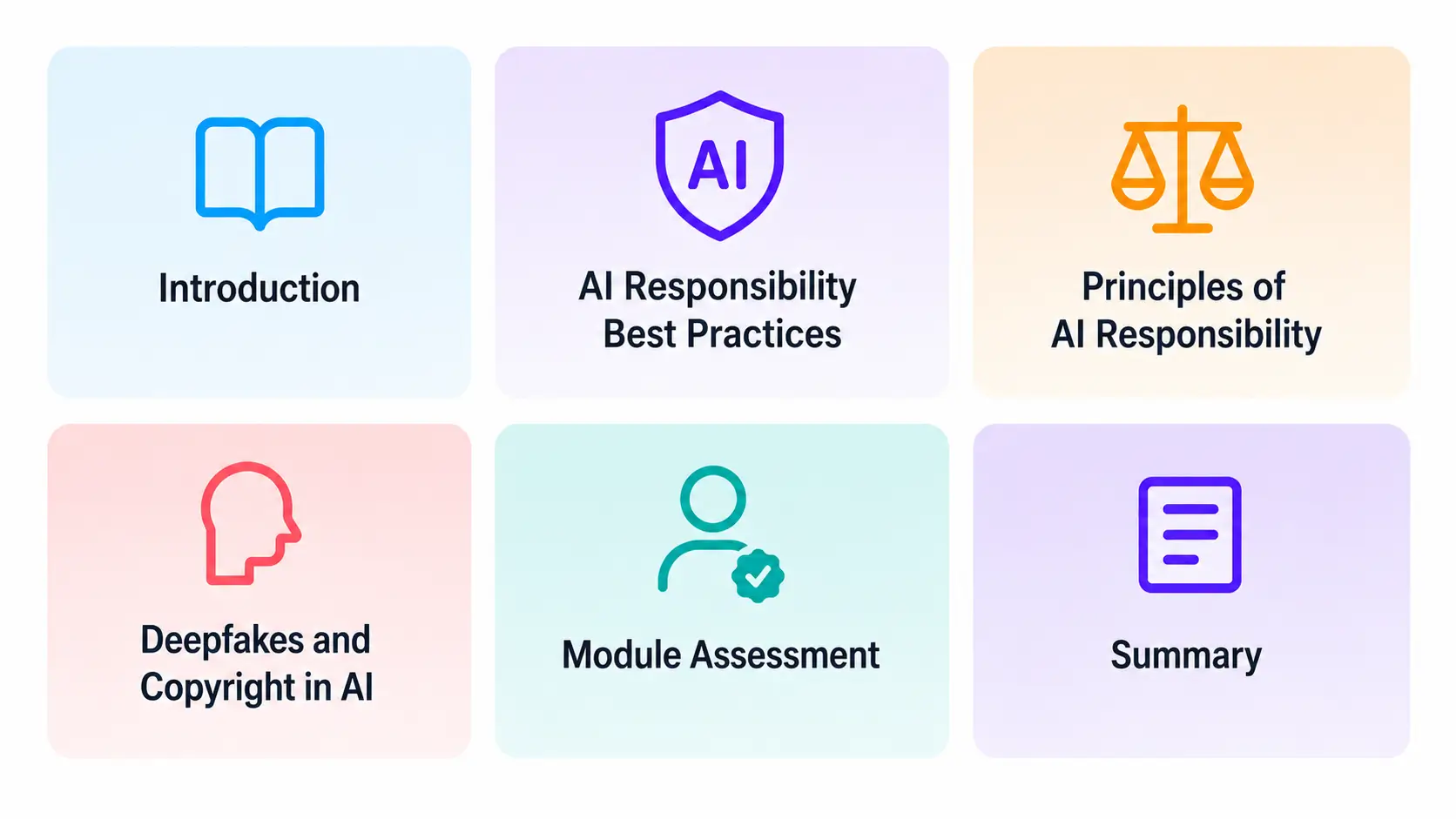
Imagine seeing a convincing celebrity endorsement that turns out to be a deepfake. Learn to verify AI-generated content and examine privacy, bias, transparency and legal liability.
Using AI responsibly: Best practices
Responsible collaboration with AI means understanding its capabilities, staying informed and checking its outputs.
▶ Watch course video ↗Understand AI
Grasp the basics and capabilities of AI.
Stay informed
Keep up with advances and ethical discussions.
Recognize AI’s blind spots
Identify and question biases reflected in training data.
Prioritize safety and privacy
Choose services that respect security and data privacy.
Cross-verify AI-generated content
Check claims against multiple credible sources.
Evaluate and refine content
Check facts, sources, purpose, audience and differing perspectives.
Ensure clear policies
Check service rules and usage guidelines.
Promote AI for good
Support healthcare, education and environmental goals.
Join the conversation
Discuss responsible use in communities and workplaces.
Principles of responsible AI
Six principles help create AI systems that respect rights and earn trust.
▶ Watch course video ↗Accountability
Define clear responsibilities for AI impacts.
Inclusiveness
Make AI accessible and beneficial for everyone.
Reliability & Safety
Test, validate, monitor and manage errors.
Fairness
Assess and reduce unfair bias.
Transparency
Help users understand AI decisions.
Privacy & Security
Protect data and collect only what is necessary.
Deepfakes and copyright in AI
Deepfakes can mimic real people and create risks of misinformation, impersonation and copyright infringement. Protect creators’ rights, verify digital content and support public awareness, safety practices and evolving legal safeguards.
Summary
Responsible AI requires evaluating generated content, addressing deepfake risks and considering privacy, bias, transparency and legal liability.
Module assessment
1. Which of the following best evaluates the ethical implications of AI-generated content?
2. Which of the following best assesses the ethical and security concerns associated with deepfakes?
3. Which of the following best evaluates the global human-AI interactions by analyzing key factors such as data privacy, algorithmic bias, transparency, and legal liability?
Explore AI for All
Introduction
AI is improving accessibility with navigation support, real-time captions, text-to-speech, image descriptions and workplace assistance.
The impact of AI on accessibility
AI tools help remove barriers for people with diverse abilities, from braille literacy initiatives to employment opportunities for neurodivergent individuals.
Impact of AI in job roles
AI changes work across finance, healthcare, energy, manufacturing, retail, government and agriculture. Examples include fraud detection, diagnostic support, wind-farm optimization and personalized retail experiences.
AI as an ally for humanitarian action
AI can help forecast natural disasters, coordinate crisis responses and optimize resources for people in need.
Inclusive AI with Copilot
Copilot can assist with writing, summarizing information, voice commands and generating descriptions, reducing barriers to everyday technology.
Summary
AI can enhance accessibility, create new ways of working and improve humanitarian action. Continue learning and evaluate AI critically and responsibly.
Congratulations!
You have reached the end of the AI Fluency learning content. This page does not register course completion or issue an official certificate.
Module assessment
1. How are AI initiatives enhancing accessibility for individuals with disabilities?
2. Which of the following statements best illustrates the transformative effect of AI in the energy sector?
3. Which of the following best demonstrates the effectiveness of AI in enhancing humanitarian action?
Learning content adapted from the material supplied for this academy. Some original course videos were not supplied with direct links; these are not embedded. Quiz feedback is for practice only. No login, official certificate or email delivery is provided.